
Menu
Others
TB— Self prelim examination and its current status in Taiwan universities
Dear NCUers,
Tuberculosis (TB), a contagious, infectious disease, is one of big concerns in Taiwan Public Health. Please be cautious if you encounter suspicious symptom. Immediately seek for medical check-up if you got five points or above based on the symptoms in the following table.
We intend to lower down TB prevalence as much as possible in Taiwan as imposed by the Law of Infectious Disease Control. Please help yourself and us.
Warmth Regards from Health Center
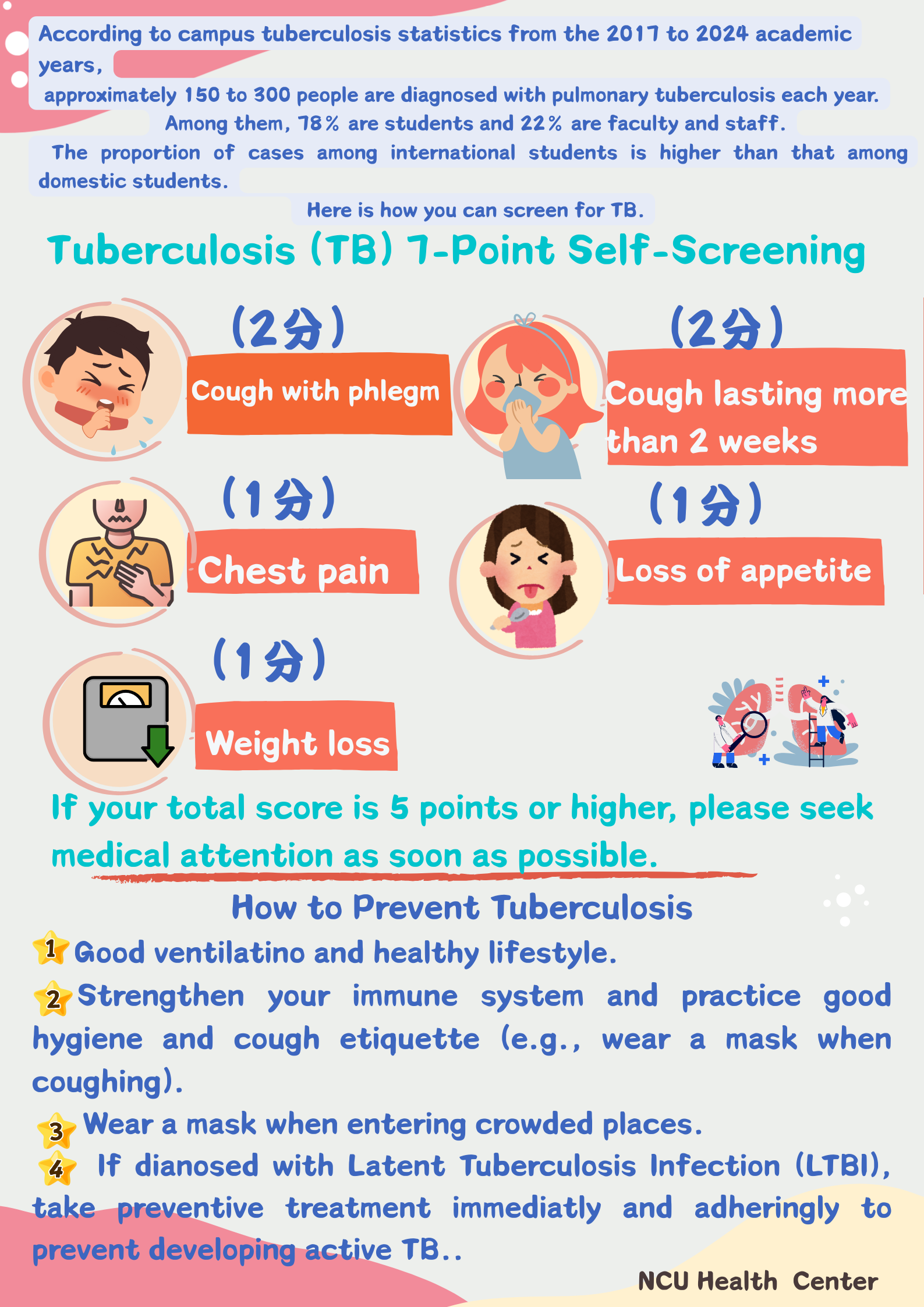
**Current Status and Prevention of Tuberculosis on University Campus**
According to campus tuberculosis statistics from 2017 to 2024, approximately 150 to 300 people are diagnosed with pulmonary tuberculosis each year. Among them, about 78% are students and 22% are faculty and staff. The proportion of confirmed cases among international students is significantly higher than that among domestic students, indicating that international students are a key target group for tuberculosis prevention and control on campus.
**1. Introduction to Tuberculosis**
Tuberculosis (TB) is caused by an aerobic, acid-tolerant bacterium known as *Mycobacterium tuberculosis*. After the initial infection, about 95% of individuals do not develop the disease due to their immune response. Tuberculosis can occur in any organ or tissue of the body and is classified according to the affected site into: (1) pulmonary tuberculosis and (2) extrapulmonary tuberculosis. Both types require complete medical treatment. In Taiwan, TB cases occur throughout the year. The incidence rate is higher in males than in females, and higher among the elderly than among younger populations.
**2. Mode of Transmission**
Tuberculosis is mainly transmitted through droplets and airborne particles. When a person with infectious TB coughs, spits, speaks, sings, or laughs, droplets containing TB bacteria are released into the air. Others may become infected if they inhale these droplet nuclei suspended in the air. Tuberculosis is not transmitted through clothing or eating utensils.
**3. High-Risk Groups**
The following groups are at higher risk of developing tuberculosis:
1. Close contacts of confirmed TB cases
2. Individuals with diabetes
3. People with malnutrition
4. Individuals who use immunosuppressive drugs long-term (such as corticosteroids)
5. People with immunodeficiency (weak, absent, or unable to fight infections)
6. Residents of mountainous or remote areas
**4. Clinical Symptoms**
1. Early symptoms are often mild and nonspecific.
2. If a cough lasts longer than two weeks, medical evaluation should be sought as soon as possible.
3. Individuals with an initial infection who do not develop symptoms may still develop the disease later if their immune system weakens.
Common symptoms include: cough lasting more than two weeks, weight loss, fever, and night sweats.
**5. Latent Tuberculosis Infection (LTBI)**
When TB bacteria enter the body, they may become enclosed within granulomas in the lungs. If the immune system is strong enough, the bacteria can be controlled without causing active disease. This asymptomatic and non-infectious state is called **latent tuberculosis infection (LTBI)**.
**6. Factors Affecting Transmission**
The length of contact with an infectious TB patient and whether the shared environment is well ventilated are important factors influencing TB transmission. However, if the immune system becomes weakened, latent infection may progress to active tuberculosis, which can then spread to others.
**7. Treatment and Prognosis**
Effective anti-tuberculosis medications are currently available. After a TB patient receives appropriate anti-TB treatment and takes the medication consistently for about 14 days, the infectiousness is significantly reduced. As long as patients follow the physician’s instructions, take medication regularly, and complete the full course of treatment, tuberculosis can be cured.
**Source:**
Taiwan Centers for Disease Control, Ministry of Health and Welfare – Campus Tuberculosis Prevention and Control Section.
Phone: 03-4227151#57270、03-2804814
Fax: 03-4272405
Email: ncu7270@ncu.edu.tw
Address: No. 300, Zhongda Rd., Zhongli District, Taoyuan City 320317, Taiwan (R.O.C.)
Views: 0
Copyright © Health Care Division, National Central University
National Central University - Health Center