Menu
Others
Issue 503 – How to Use a Nasal Irrigation Device Properly
Seasonal temperature changes can easily irritate the nasal mucosa and trigger allergies, and many people suffer from allergic rhinitis symptoms.
In recent years, many people have chosen to use nasal irrigation devices to clean their nasal passages, relieving the discomfort of allergic rhinitis through nasal washing. However, with so many different types of nasal irrigation devices on the market, do consumers know how to choose and use them correctly?
When we breathe air, the nasal passages secrete nasal mucus and fluids to trap and eliminate foreign particles. This acts as the body’s natural defense mechanism, filtering out dirt and particles in the air. However, when the quantity of foreign particles becomes excessive or harmful, surpassing the capacity of the nasal mucosa, some people turn to nasal irrigation devices to help clean their nasal passages.
A nasal irrigation device is a tool used for cleaning the nasal passages. It uses manual squeezing or an electric pump to deliver saline solution into the nose. The solution flows through the nasal vestibule, sinuses, and into the nasopharynx, exiting through the other nostril. The flow of water and the pressure created during irrigation help clean the nasal passages. Users can apply the nasal irrigation device in the following three scenarios:
- When the nasal mucosa is insufficient to clear out foreign particles, use the nasal irrigation device to clean the nose.
- For acute rhinitis caused by a cold, the body often has self-healing capabilities. If the acute rhinitis doesn’t improve after three weeks (i.e., it progresses to chronic rhinitis), doctors will recommend non-invasive nasal irrigation to alleviate symptoms. In addition to medication, patients with allergic rhinitis can also use nasal irrigation as an adjunct to reduce the time allergens remain in the nasal passages. Acute sinusitis caused by a cold may turn into chronic rhinitis (sinusitis) due to improper treatment or other factors (e.g., stronger bacterial infections or weaker immune systems), indicating a loss of the nasal self-healing ability. In such cases, nasal irrigation is also recommended as an adjunct treatment.
- After nasal or sinus surgery, when the mucosa is damaged, it’s important to keep the wound clean for normal recovery. Nasal irrigation can help remove blood clots and scabs, facilitating healing.
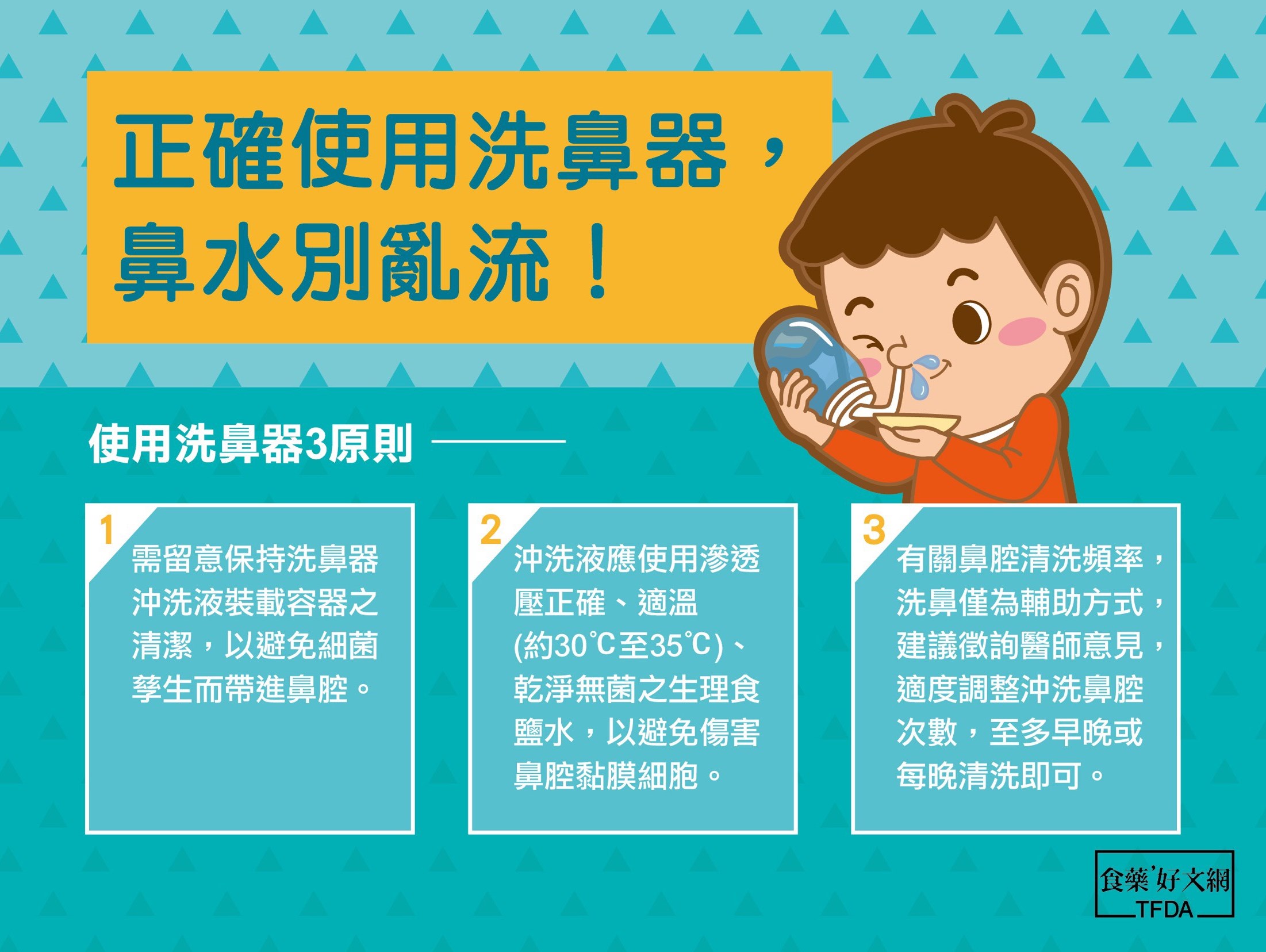
Three principles for using a nasal irrigation device:
- Be mindful of keeping the container for the irrigation solution clean to prevent bacterial growth that could be introduced into the nasal passages.
- The irrigation solution should be isotonic, at the right temperature (approximately 30°C to 35°C), and sterile saline solution to avoid damaging the nasal mucosa cells.
- Regarding the frequency of nasal cleaning, clinical studies have yet to reach a conclusion. However, since the nasal passages have a natural cleaning mechanism, nasal irrigation is only an adjunctive method. It’s recommended to consult a doctor and refer to the aforementioned situations for nasal irrigation, adjusting the frequency as necessary. It’s generally sufficient to clean the nasal passages once in the morning and evening or just once per evening.
The Food and Drug Administration (FDA) reminds you that nasal irrigation devices are classified as Class I medical devices. Before purchasing, consumers should follow the principle of "check the certification and read the instructions" to ensure safe and reliable use.
Source: Taiwan Food and Drug Administration - Good Articles - https://reurl.cc/E6apxv
Phone: 03-4227151#57270、03-2804814
Fax: 03-4272405
Email: ncu7270@ncu.edu.tw
Address: No. 300, Zhongda Rd., Zhongli District, Taoyuan City 320317, Taiwan (R.O.C.)
Views: 0
Copyright © Health Care Division, National Central University
National Central University - Health Center