
Menu
Others
Issue 506 – Oral Contraceptives: Consistency is Key!
Many women with contraceptive needs choose to use oral contraceptives. However, how should they be taken, and when, to achieve maximum efficacy? The Food and Drug Administration (FDA) consulted Dr. Annie Kuo, an obstetrician and gynecologist at Chung Shan Medical University Hospital, to provide further clarification.
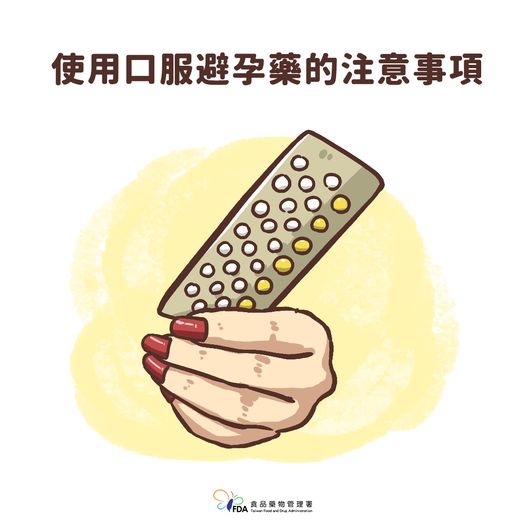
Do Not Discontinue Medication Abruptly, As It May Lead to Irregular Menstrual Cycles
Dr. Kuo explains that oral contraceptives are divided into two categories: pre-coital contraceptives and post-coital contraceptives. Pre-coital contraceptives are further classified into 21-day and 28-day designs. The 21-day regimen requires a 1-week break after three weeks of use, during which a withdrawal bleed occurs. After the break, the next 21-day cycle begins on the 8th day. The 28-day contraceptive, however, does not require a break. After finishing one cycle, the next begins immediately. The last four days of this cycle consist of "placebo" pills, which do not contain active ingredients, and a withdrawal bleed will occur during this period.
When starting the first pack of pre-coital contraceptives, the first pill should be taken within the first three days of menstruation, but no later than the fifth day. After that, the pills should be taken at the same time each day to maintain a consistent concentration in the body. If a dose is missed, it should be taken within 12 hours to maintain its efficacy. If more than 12 hours have passed, the contraceptive effect may be compromised. In this case, take the missed pill immediately and use an additional barrier method, such as a condom, to ensure contraception. If more than one day is missed, take an additional pill each day until returning to the original schedule, and use condoms throughout the cycle.
It is important to note that stopping the medication abruptly may lead to irregular menstrual cycles.
Consistent Use Maximizes Contraceptive Effectiveness
Some individuals mistakenly believe that pre-coital contraceptives should only be taken before sexual activity, which can result in contraceptive failure. Dr. Kuo stresses that oral contraceptives must be taken consistently every day to be effective. In some cases, even though people take the pills daily, inconsistent timing—taking them at different times of the day—can lead to fluctuations in the drug's concentration in the body, possibly causing breakthrough bleeding. Long-term use of oral contraceptives does not affect fertility, but it may reduce menstrual flow or cause missed periods. Dr. Kuo suggests that after using them for six months to a year, it is advisable to take a break from the medication.
Post-Coital Contraceptives: Only for Emergency Use
What is the difference between pre-coital and post-coital contraceptives? Dr. Kuo explains that the mechanisms of action for these two types of contraceptives differ. Pre-coital contraceptives prevent ovulation, making it impossible for sperm to fertilize the egg. Post-coital contraceptives delay ovulation, thus reducing the chance of fertilization. However, if ovulation has already occurred during sexual intercourse, post-coital contraceptives will not be effective. Overall, post-coital contraceptives have an efficacy rate of about 70-80%, while pre-coital contraceptives can achieve 99% effectiveness.
Dr. Kuo reminds that post-coital contraceptives are high-dose, single-use medications and should only be used as emergency contraception. They must be taken within 72 hours of unprotected intercourse, with earlier usage offering more effectiveness. If menstruation does not occur as expected after taking post-coital contraceptives, a pregnancy test should be performed to confirm whether pregnancy has occurred.
Important! Not Everyone Can Use Oral Contraceptives
Dr. Kuo cautions that oral contraceptives may cause side effects, such as edema, headaches, gastrointestinal discomfort, breast tenderness, and mood swings. The side effects may vary depending on an individual’s health status. It is important to note that some people should avoid using oral contraceptives, including those with liver or kidney disorders, severe gastrointestinal diseases, a history of thrombosis, a family history of clotting disorders, heavy smokers (especially those over 35), and individuals with endometrial hyperplasia, uterine tumors, breast tumors, or unexplained vaginal bleeding.
The FDA reminds that both pre-coital and post-coital contraceptives are prescription medications and must be prescribed by a physician following a thorough evaluation. To achieve the maximum contraceptive effect, users must follow the correct usage instructions. If any adverse effects occur, consulting a physician is advised. Dr. Kuo also recommends using condoms in conjunction with oral contraceptives during sexual activity to reduce the risk of sexually transmitted infections.
Source: FDA Consumer Articles, https://article-consumer.fda.gov.tw/subject.aspx?subjectid=2&id=3712
Phone: 03-4227151#57270、03-2804814
Fax: 03-4272405
Email: ncu7270@ncu.edu.tw
Address: No. 300, Zhongda Rd., Zhongli District, Taoyuan City 320317, Taiwan (R.O.C.)
Views: 0
Copyright © Health Care Division, National Central University
National Central University - Health Center