
Menu
Others
How to Choose and Use Toothpaste for Sensitive Teeth
Many people experience sharp or aching discomfort when their teeth come into contact with cold, hot, sour, or sweet foods. With so many types of toothpaste for sensitive teeth on the market, each containing different ingredients and working in different ways, consumers may feel unsure about what to choose and how to use them properly.
The Taiwan Food and Drug Administration (TFDA) invited dentist Dr. Huang Mao-Shuan from the Taiwan Dental Association to explain the common causes of tooth sensitivity, how desensitizing toothpaste works, and important points to keep in mind when using it.
Why Do Teeth Become Sensitive?
Dr. Huang explained that common causes of tooth sensitivity include gum recession, enamel wear, teeth grinding, brushing too hard, tooth decay, and periodontal disease.
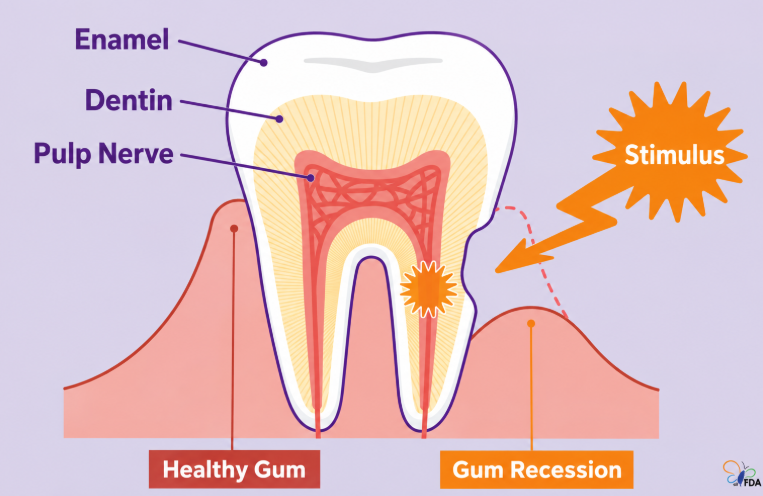
When the protective enamel is damaged, or when gum recession exposes the tooth root, tiny channels in the dentin, known as dentinal tubules, become exposed to cold, heat, acidic foods, or sweets. These stimuli can then travel toward the dental pulp and nerves, causing a brief but noticeable sharp or aching sensation.
How Does Desensitizing Toothpaste Work?
The main difference between desensitizing toothpaste and regular toothpaste is the presence of ingredients designed to reduce tooth sensitivity. These ingredients generally work in two ways:
1. Reducing nerve sensitivity
Certain ingredients help reduce the transmission of pain signals from the tooth to the nerve.
2. Blocking dentinal tubules
Other ingredients form a protective layer over the tooth surface and help seal exposed dentinal tubules, reducing the chance that external stimuli will reach the nerve.
Because these effects take time to build up, desensitizing toothpaste is not an instant pain-relief product. It usually needs to be used consistently for several weeks before noticeable improvement occurs.
Consistent Use Is Important
Dr. Huang noted that the most important principle when using desensitizing toothpaste is continued use. Whether the toothpaste works by reducing nerve transmission or sealing dentinal tubules, its effects generally require time to accumulate.
If you have sensitive teeth, desensitizing toothpaste can usually be used as your regular daily toothpaste. There is generally no need to alternate it with standard toothpaste, since doing so may reduce the consistency of its effect.
Daily Habits Also Matter
Choosing the right toothpaste is only part of managing sensitive teeth. Good oral hygiene habits are equally important.
Brushing too hard, frequently consuming acidic foods or drinks, and teeth grinding may continue to irritate the teeth and reduce the effectiveness of desensitizing toothpaste. It is recommended to use a soft-bristled toothbrush and proper brushing techniques to minimize unnecessary wear on the teeth and gums.
Many desensitizing toothpastes also contain fluoride, which can help strengthen enamel and prevent tooth decay in addition to reducing sensitivity. People at higher risk of cavities or older adults may also consider professional fluoride treatment based on their dentist’s advice.
When Should You See a Dentist?
Desensitizing toothpaste is mainly intended to relieve sensitivity caused by exposed dentin. Not all tooth pain can be treated with toothpaste.
You should seek dental care if:
- Symptoms do not improve after using desensitizing toothpaste consistently for several weeks, or if they become worse.
- You experience severe pain, pain that continues after exposure to hot or cold temperatures, nighttime pain, spontaneous pain, or significant discomfort when chewing.
- Sensitivity is limited to a single tooth.
- The sensitive area gradually becomes larger.
- There may be another dental problem, such as tooth decay, a cracked tooth, or inflammation of the dental pulp.
Desensitizing toothpaste can be a useful part of daily oral care, but if symptoms persist or repeatedly return, a professional dental examination is recommended to identify the underlying cause and provide appropriate treatment.
Source: Taiwan Food and Drug Administration (TFDA)
Phone: 03-4227151#57270、03-2804814
Fax: 03-4272405
Email: ncu7270@ncu.edu.tw
Address: No. 300, Zhongda Rd., Zhongli District, Taoyuan City 320317, Taiwan (R.O.C.)
Views: 0
Copyright © Health Care Division, National Central University
National Central University - Health Center